How to Evaluate Healthcare Candidates in the Age of Fraudulent Profiles
 By Wisedoc | Published on August 4, 2026 | 10 min read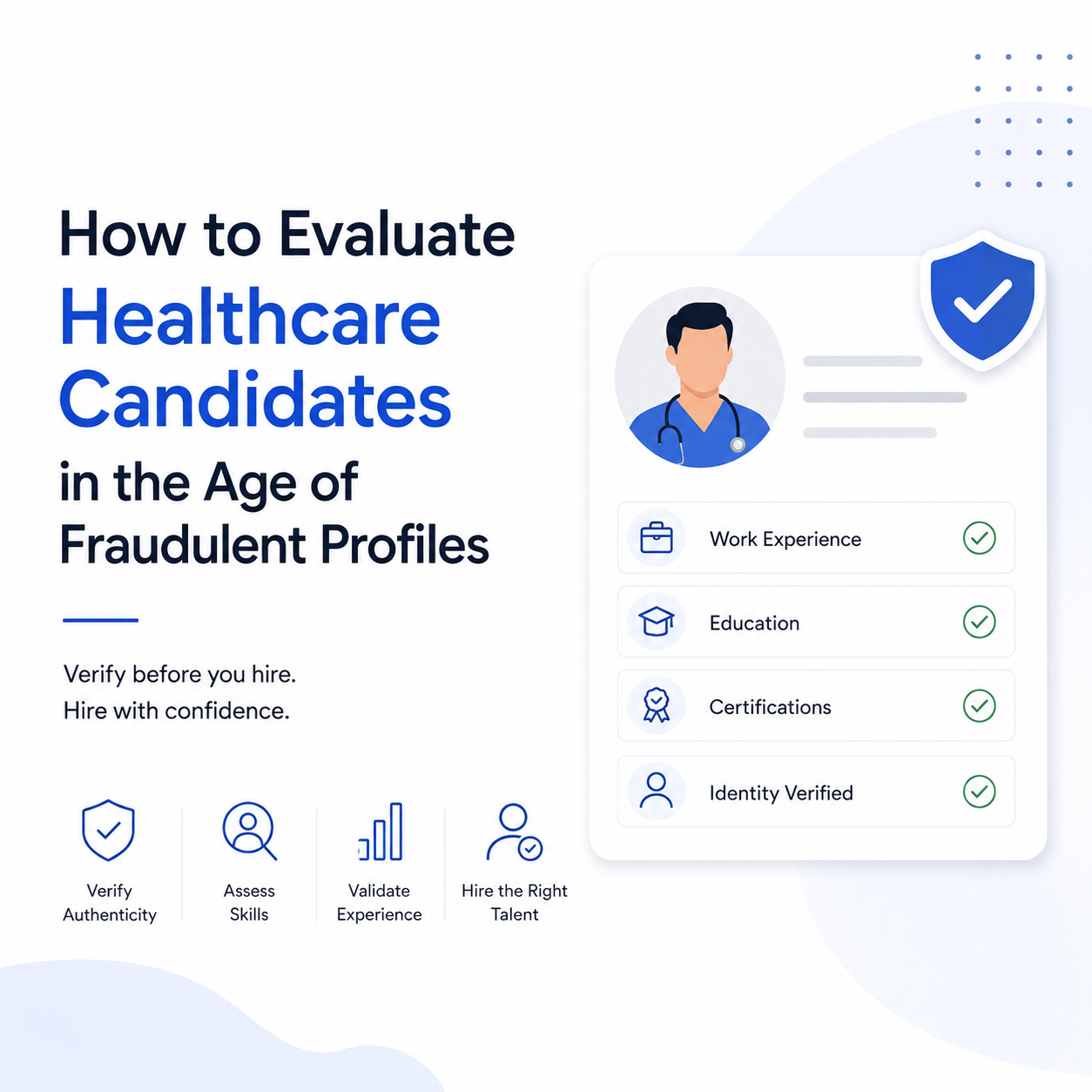
The healthcare staffing industry is facing a new challenge. While demand for qualified professionals continues to grow, so does the number of fraudulent candidate profiles entering the hiring pipeline. Recruiters are no longer evaluating resumes alone—they are verifying whether the information behind those resumes is genuine.
With AI-generated resumes, fake employment histories, proxy interviews, and fabricated certifications becoming increasingly common, healthcare organizations need a smarter and more reliable approach to candidate evaluation.
Why Candidate Fraud Is Rising in Healthcare Recruitment
Advancements in AI have made it easier than ever to create convincing resumes and polished professional profiles. Candidates can now generate resumes in minutes, exaggerate their work experience, or even use AI tools during interviews.
For healthcare staffing agencies, hiring the wrong candidate can lead to compliance issues, patient safety risks, financial losses, and damage to client relationships. This makes candidate verification just as important as candidate sourcing.
Common Types of Fraudulent Candidate Profiles
Recruiters should be aware of several warning signs during the hiring process, including:
- AI-generated resumes with exaggerated experience.
- Fake employment history or fabricated projects.
- Proxy interviews where another person attends the assessment.
- Incomplete or inconsistent LinkedIn profiles.
- Fake certifications or unverifiable credentials.
- Candidates using AI tools to answer technical interview questions.
These fraudulent practices make traditional resume screening insufficient for modern healthcare recruitment.
How to Evaluate Healthcare Candidates More Effectively
Organizations should adopt a verification-first hiring strategy instead of relying solely on resumes and interviews.
A modern candidate evaluation process should include:
- Resume authenticity verification.
- LinkedIn profile validation.
- Employment and work history verification.
- Skills-based assessments.
- AI-powered video interviews with behavioral analysis.
- Objective candidate scoring based on verified data.
By combining these evaluation methods, recruiters can identify genuine healthcare professionals while significantly reducing hiring risk.
The Importance of AI in Candidate Verification
Artificial intelligence is transforming recruitment by helping hiring teams detect inconsistencies that manual screening often misses. AI can analyze resumes, verify candidate information, compare profiles against job requirements, and identify unusual patterns that may indicate fraud.
Instead of replacing recruiters, AI enables them to make faster, more informed hiring decisions while focusing their time on qualified candidates.
Benefits of a Verification-First Hiring Process
Implementing a structured candidate verification process provides several advantages:
- Reduces the risk of fraudulent hires.
- Improves hiring accuracy.
- Saves recruiter screening time.
- Enhances compliance and documentation.
- Builds greater trust with healthcare clients.
- Improves overall quality of hire.
The Future of Healthcare Hiring
Healthcare recruitment is evolving rapidly, and recruiters must evolve with it. As fraudulent candidate profiles become more sophisticated, hiring teams need tools and processes that prioritize verification alongside evaluation.
The future of healthcare hiring belongs to organizations that verify before they hire. By combining AI-powered candidate screening, skills validation, employment verification, and objective assessments, recruiters can confidently identify genuine healthcare professionals and make better hiring decisions.
Conclusion
Finding qualified healthcare talent is challenging enough without the added risk of fraudulent profiles. A verification-first recruitment strategy helps staffing agencies and healthcare organizations hire with greater confidence, reduce risk, and build stronger, more reliable workforces.
As the hiring landscape continues to change, the organizations that invest in smarter candidate evaluation will be the ones that consistently attract and retain the best healthcare professionals.
Good or bad, we'd love to hear your thoughts. Find us on X or connect with us on LinkedIn.
Here are some related articles you may find interesting
Resume Fraud vs. Candidate Fraud: What's the Difference?
Learn how to build a scalable high-volume candidate screening workflow using AI resume screening, candidate ranking, fraud detection, assessments, interviews, and human review.
Resume Fraud vs. Candidate Fraud: What's the Difference?
Resume fraud involves false information in applications, while candidate fraud can include identity misrepresentation, proxy interviews, fake profiles, and assessment manipulation. Learn how recruiters can detect both.
The Real Cost of a Bad Healthcare Hire
A bad healthcare hire can create recruitment costs, overtime, lost productivity, compliance risks, and operational disruption. Learn how better screening can reduce hiring risk.
How AI Is Changing the First 10 Minutes of Candidate Evaluation
AI is transforming the first 10 minutes of candidate evaluation by analyzing skills, experience, job fit, and risk signals faster. Learn how recruiters can combine AI with human judgment.